It has been 75 years since the heyday of Eames, Wegner, and Nakashima. In fashion, trends last a season. In architecture, a decade. Yet Mid-Century Modern (MCM) furniture is more popular today than it was in 1955. Why?
I believe the answer lies not in style, but in philosophy. MCM wasn't just a "look." It was a reaction to a world that was becoming increasingly cluttered and complex. It was a return to honesty.
Before the 1940s, furniture was heavy. It was dark, ornate, and burdened with unnecessary decoration—Victorian scrolls, Edwardian heavy skirts. It shouted wealth. MCM whispered utility. It stripped away the cladding to reveal the structure. It said: "A chair leg holds up the chair. It does not need to look like a lion's paw."
Form Follows Function (For Real)
The Bauhaus mantra "Form follows function" is often quoted, but rarely practiced. In MCM design, it is law.
Consider the tapered leg, the hallmark of the style. Why are legs tapered? It isn't just aesthetic. A table needs the most strength at the top joint, where it connects to the apron. It needs very little strength at the floor. By shaving away the excess wood at the foot, the designer lightens the visual and physical weight of the piece without compromising structural integrity. It is efficient engineering made beautiful.
The Influence of George Nakashima
While the Danish Modernists were perfecting the factory curve, George Nakashima in Pennsylvania was introducing the soul of the tree to the conversation. He is the spiritual godfather of everything we do at Carpceter.
Nakashima introduced the "Live Edge"—keeping the natural bark line of the tree on the finished piece. Before him, knots and wandering grain were considered defects. He saw them as the autobiography of the tree.
He famously said: "There must be a union between the spirit of the wood and the spirit of man." This philosophy bridges the gap between the clean lines of MCM and the organic unpredictability of nature. It creates furniture that feels disciplined but not sterile.
Why It Fits Modern Life
Today, we live in smaller spaces. We move frequently. We are overwhelmed by digital noise.
MCM furniture is designed for this life. It is visually light, thanks to raised legs that let you see the floor underneath, making small rooms feel bigger. It is functional, often serving multiple purposes. And visually, its lack of ornament provides a resting place for the eye.
A solid Walnut MCM credenza anchors a room. It adds warmth without adding clutter. It works in a Brooklyn loft, a Tokyo apartment, or a farmhouse in Oregon. It is the universal donor of interior design.
Our Interpretation
At Carpceter, we do not build replicas. We do not copy the Eames Lounge Chair. Instead, we build in the idiom of the era.
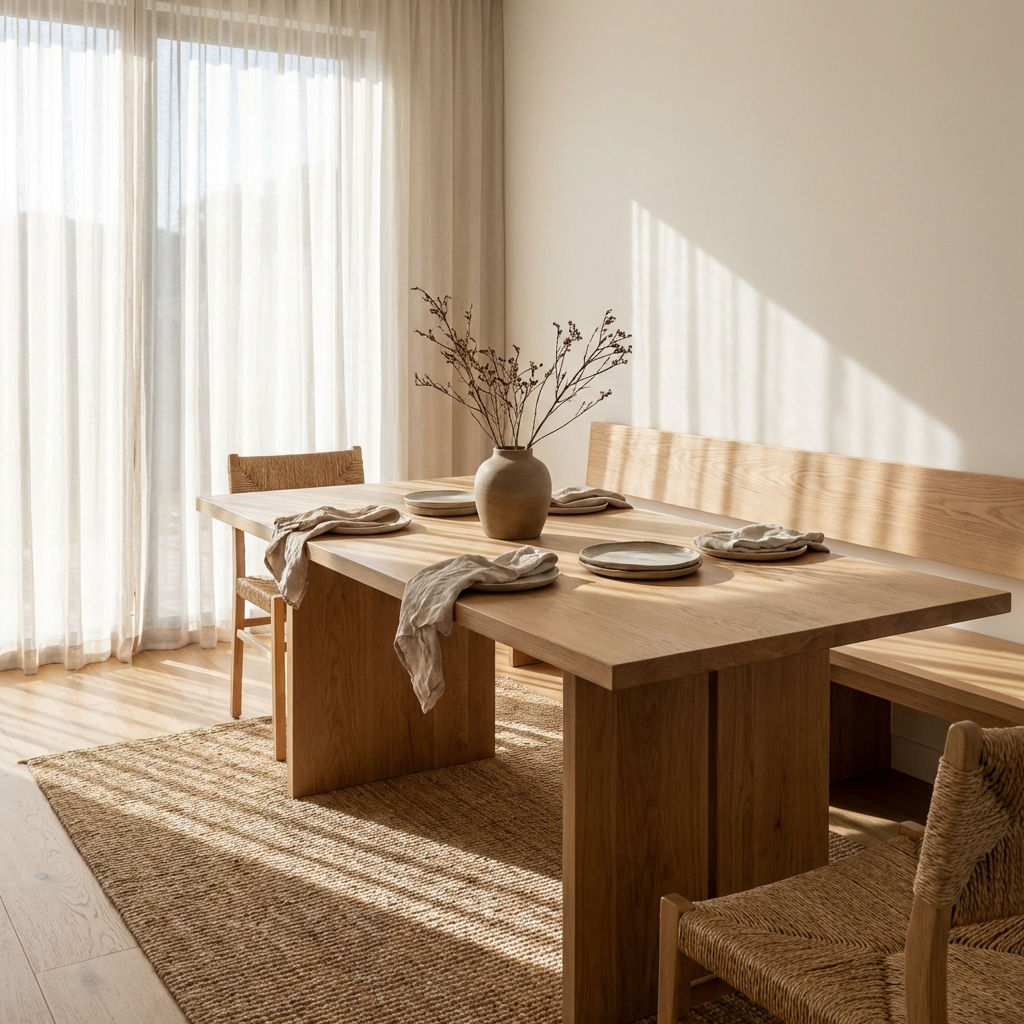
Our Summit Dining Table uses the classic bevelled edge of the 1950s (which makes the thick top look thin and floating) but pairs it with traditional Japanese joinery that requires no screws. It is Mid-Century Modern styling with 18th-century construction integrity.
We believe this is how the style evolves. We keep the clean lines and the respect for materials, but we leave behind the plywood and veneers in favor of solid, heirloom-grade timber.
See the Collection
Explore our current range of solid walnut desks and sideboards, all inspired by the clean functionalism of 1950s design.
View Collection