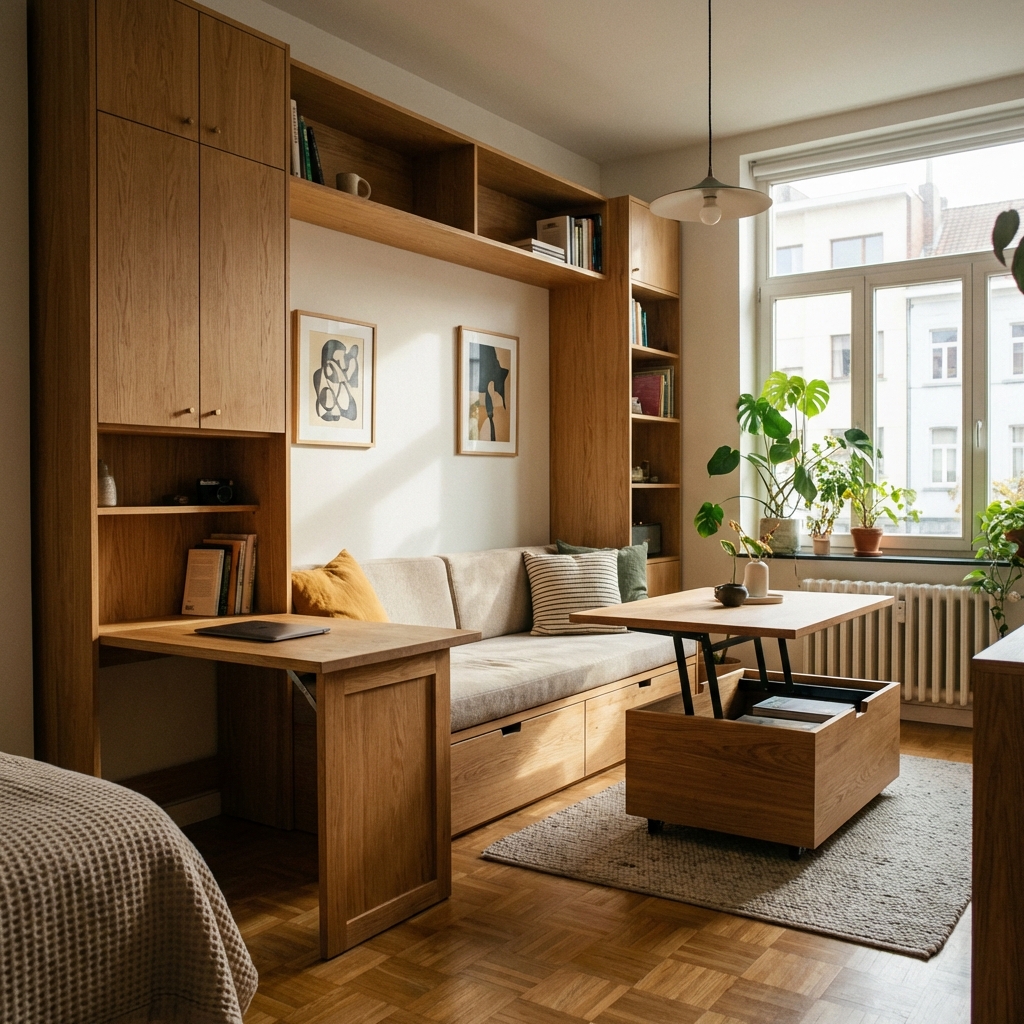
The challenge of modern urban living often boils down to a single constraint: square footage. But constraint is the mother of invention. In a small space, furniture cannot just be functional; it must be architectural.
When clients approach our atelier with floor plans for compact apartments or condos, they often assume they have to compromise. They believe they must choose between a dining table and breathing room, or between storage and visual calm. This is a fallacy. Custom joinery allows us to bend the rules of physics—or at least, the rules of perceiving space.
1. The Proportion Rule: Visual Weight vs. Physical Mass
In woodworking, we talk about "visual weight." A chunky oak farmhouse table might physically fit in a 10x10 room, but it will make the room feel claustrophobic. For small spaces, I always recommend floating elements and tapered legs.
A mid-century modern inspired leg that tapers toward the floor allows light to pass underneath the piece, tricking the eye into seeing more floor space. When we build custom consoles or desks, we often wall-mount them using French cleats. By eliminating legs entirely, the floor stretches uninterrupted to the wall, instantly expanding the perceived volume of the room.
2. Dual-Function Joinery
Mass-produced "convertible" furniture usually feels flimsy—wobbly hinges and cheap laminate. In bespoke woodworking, we engineer transformation with the solidity of a ship's hull.
One of our most requested pieces is the "Drop-Leaf library Table." When closed, it serves as a slim console (14 inches deep) against a wall. When pulled out, solid walnut leaves rise on wooden knuckles to form a dining surface for six. The mechanism isn't hidden; it's celebrated. We use brass hardware or exposed wooden slides that are beautiful enough to be seen. If you live small, every mechanism must be an aesthetic event.
3. Materiality: Light and Grain
Dark woods like Mahogany or stained Walnut radiate elegance, but they absorb light. For compact spaces, I almost always steer clients toward White Oak, Ash, or Maple.
These lighter species reflect ambient light, keeping the atmosphere airy. Furthermore, the grain selection matters. I hand-select boards with "rift sawn" grain (straight, linear lines) rather than "flat sawn" (cathedral arches). Linear grain draws the eye along the length of the piece, visually stretching it. Chaos in the grain creates visual noise; straight grain creates calm. And in a small room, calm is the ultimate luxury.
4. Verticality and Built-Ins
If you cannot build out, you must build up. Freestanding bookcases are often inefficient because they leave gaps at the top and sides. Custom built-in shelving that goes floor-to-ceiling maximizes storage while disappearing into the architecture.
We recently completed a project in a 600 sq ft loft where we built a "storage wall" from floor to ceiling using Maple plywood with solid wood edging. We integrated a fold-down desk and hidden compartments for electronics. The result wasn't just furniture; it was a new wall that happened to hold the client's entire life.
5. The "Touch" Factor
In a small home, you interact with your furniture constantly. You brush past the sideboard; your hands rest on the table edge while you work. There is no distance to hide imperfections.
This is why the finish is critical. We avoid thick, plastic-like polyurethanes. Instead, we use hand-rubbed oil finishes (like Odie's Oil or Osmo). These finishes penetrate the wood fibers, preserving the tactile warmth of the timber. When you touch the table, you feel wood, not plastic. It grounds you. It connects you to nature, even in a high-rise concrete box.
Commissioning Your Piece
Are you struggling with a challenging floor plan? We specialize in "impossible" spaces. Bring us your measurements, and let us engineer a solution that will last for generations.
Start the Conversation