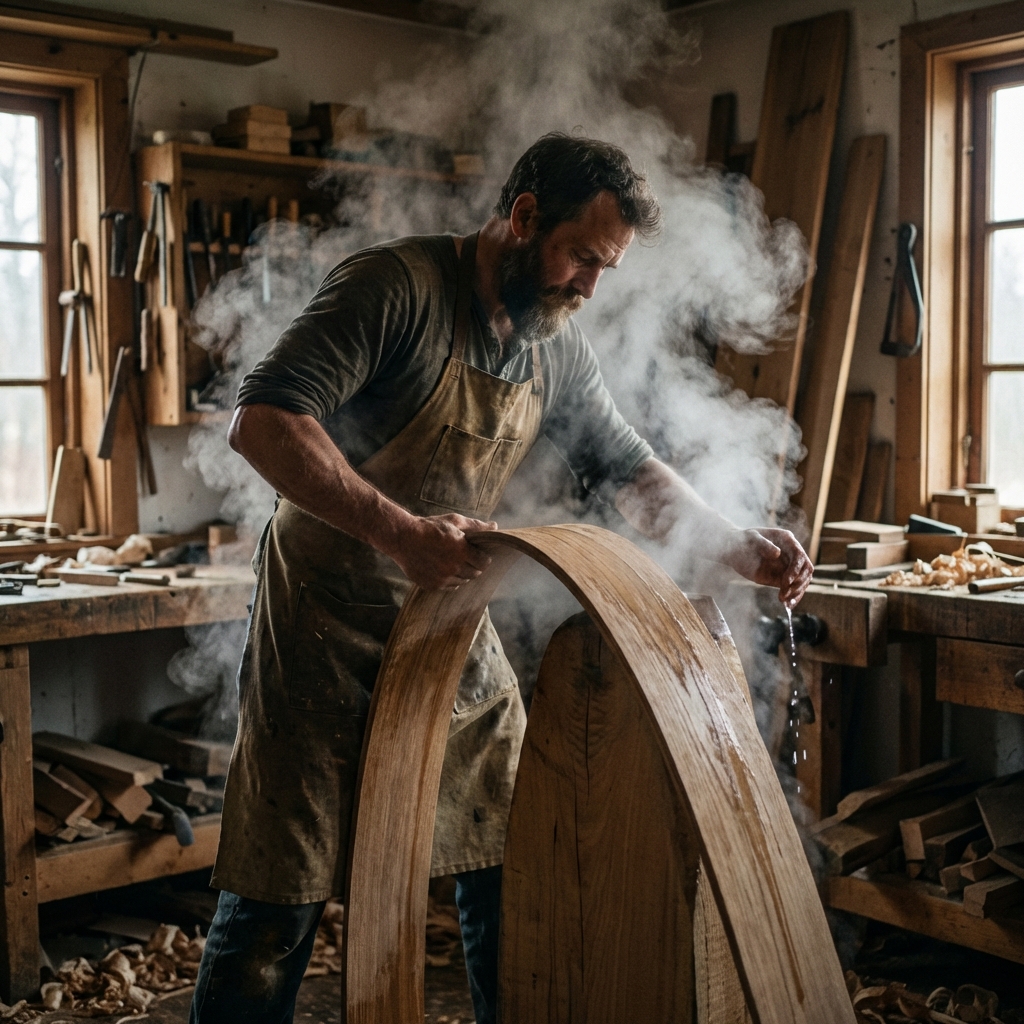
Wood is rigid. It is stubborn. It grows straight towards the sun and resists any force that tries to deviate it. To bend it, you must first understand it, and then, gently, break its will without breaking its spirit.
In modern furniture manufacturing, if a curved shape is required, the solution is usually to cut a curve out of a flat board (wasting mass amounts of material) or to laminate thin layers of veneer with glue (creating a rigid, static plywood). Both methods sever the grain. When you cut a curve from a straight board, you create "short grain"—weak points where the wood fibers are prone to snapping.
Steam bending is different. It is an ancient technique, used by Vikings to build longships and by the Windsor chair makers of the 18th century. It respects the continuity of the fiber. Instead of cutting across the grain, we soften the lignin—the natural glue that holds wood cells together—and slide the fibers past each other into a new shape. Once cooled, the wood "remembers" this shape and holds it forever, retaining all its original strength.
The Science of Heat and Moisture
To bend wood, we need two things: heat and water. We place air-dried lumber (usually green wood is best, but air-dried works with care) into a custom-built steam box. The rule of thumb is one hour of steaming per inch of thickness.
Inside the box, the temperature reaches 212°F (100°C). At this point, the lignin transitions from a solid to a plastic state. Think of it like hard taffy turning soft in the sun. The cellulose fibers, which give wood its tensile strength, remain intact, but the matrix holding them behaves like a viscous liquid.
This is the critical window. Once the wood is removed from the steam box, we have roughly 30 to 60 seconds to bend it before it cools and rigidifies. It is a dance of speed and precision.
The Compression Strap
You cannot simply grab a hot board and bend it over your knee. Wood stretches very poorly (about 1-2%), but it compresses remarkably well (up to 20%). If you just bend a stick, the outside radius will stretch and splinter apart.
The secret tool of the steam bender is the compression strap. This is a steel band placed on the outside of the curve, with end-blocks secured tightly against the ends of the wood. As we bend the wood around a form, the steel strap prevents the outside fibers from stretching. Instead, it forces the inside fibers to compress, bunching up like an accordion (though microscopic and invisible to the naked eye).
This compression creates an incredibly dense, strong curve. A steam-bent chair leg is significantly stronger than a cut chair leg of the same dimension because the fibers run continuously from top to bottom.
Identifying Suitable Species
Not all wood wants to bend. Softwoods like Pine or Fir will simply crush or snap. Tropical hardwoods like Teak are often too oily.
The best bending woods are temperate hardwoods with long, straight grain. White Oak is the king of bending, followed closely by Ash, Hickory, and Walnut. Cherry bends beautifully but can be unpredictable. Maple is difficult.
At Carpceter, we hand-select "straight run" boards specifically for our bentwood projects. We look for logs that have not twisted during growth, ensuring the grain lines run perfectly parallel to the face of the board.
Why We Still Steam Bend
Why go through this trouble? Why maintain a dangerous boiler and risk burning our hands daily? Because there is an organic beauty to a bent limb that a CNC machine cannot replicate.
When you look at our Willow Chair or the curved apron of our Ellipse Dining Table, your eye follows the grain around the corner. It feels natural, like a tree branch in the wind. It flows. A cut curve feels static and interrupted. A bent curve feels alive.
Furthermore, it is the zero-waste option. To cut a semi-circle from a board generates 40% waste sawdust. To bend a straight board into a semi-circle generates zero waste. In a world of finite resources, this old technology is surprisingly futuristic.
Own a Piece of Living History
Our signature Archer Chair features a backrest steam-bent from a single piece of solid Oregon White Oak. Come visit the atelier to see the steaming process in action.
Inquire About Availability